Quant trading platform: algo trading without code
A quant trading platform is software for building, testing, and running trading rules based on data. Tactfolio is a quant and algo trading platform where you build those rules from blocks, backtest them on decades of daily prices, and run them in your own Alpaca account. You don’t need to write code.
- An algorithm is a set of exact rules, like “hold stocks while they trend up, bonds when they don’t”.
- On Tactfolio, you build rules from four kinds of blocks, or ask an AI assistant to build them.
- Every backtest counts trading costs and shows reality checks, so a lucky rule is easier to spot.
- Tactfolio is for slow rules, checked daily, or hourly for crypto perps. It does not do high-speed trading.
- Stock strategies are long only, in US stocks and ETFs, and trade through Alpaca only. Hyperliquid crypto perps are backtest and paper or testnet only.
Open the builderFree while we build. Look around without an account.
What a quant trading platform does#
Quant trading, short for quantitative trading, means trading by rules built from data instead of by feel. Algorithmic trading, or algo trading, means a computer follows those rules. A platform for it does three jobs: it holds the data, it tests the rules, and it runs them.
| Job | What to look for | What Tactfolio gives you |
|---|---|---|
| Data | Clean prices that include dividends and splits | Daily prices of US-listed stocks and ETFs, plus US economic data from FRED. Hyperliquid perps on daily or hourly prices |
| Testing | Costs, honest timing, and checks for luck | A 0.05% cost per trade, a next-day-open line, and reality checks |
| Running | Orders sent for you, on a schedule | Paper accounts, and your own Alpaca account, paper or live |
Big firms run algorithms that trade in fractions of a second. That is called high-frequency trading, and FINRA, the group that oversees US brokers, has rules for firms that do it. Tactfolio is built for the slower kind: a daily plan you can stick to, such as “move to bonds when the market falls below its 10-month average”.
Kinds of algorithmic trading strategies#
Most rules-based strategies for long-term investors fall into a few groups. Each one below links to a classic strategy you can open and copy.
| Kind | The idea | A classic to study |
|---|---|---|
| Trend following | Hold an asset while its price is above its average, step aside when it isn’t | Faber’s 10-month moving average |
| Momentum | Hold what has risen the most lately | Dual momentum |
| Canary signals | Watch a few “warning” assets and get defensive when they weaken | Defensive Asset Allocation |
| Risk balancing | Split money so each holding carries a similar amount of risk | Adaptive Asset Allocation |
| Economic timing | Use data like jobs or inflation to decide | Growth-Trend Timing |
| Fixed mix | Hold set weights and rebalance on a schedule | 60/40 portfolio |
Common patterns shows how each kind is built in Tactfolio.
How to build a trading algorithm on Tactfolio#
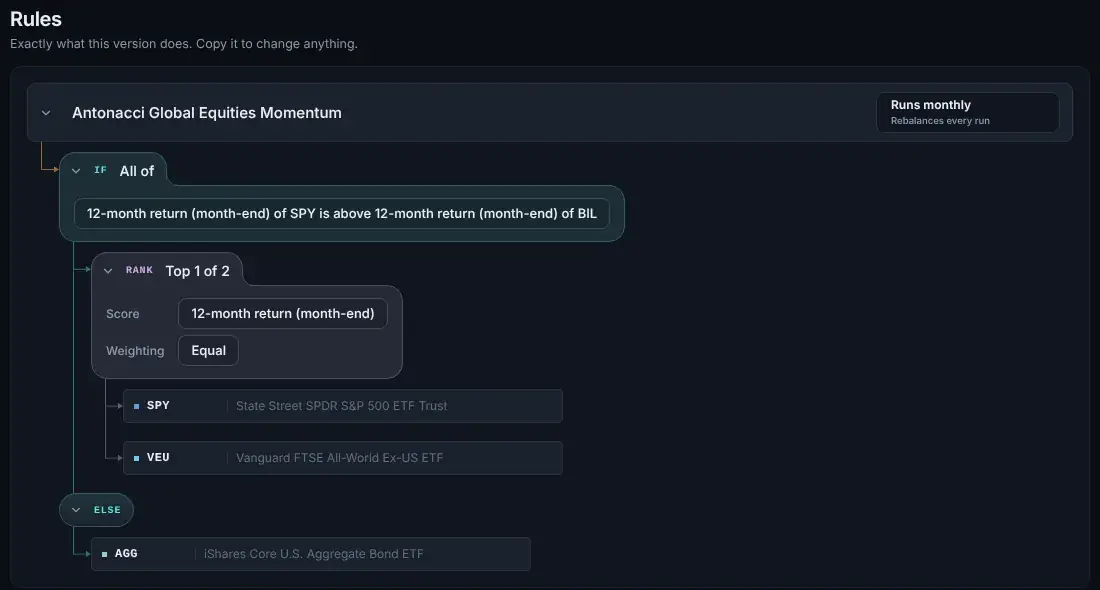
A Tactfolio strategy is a small tree of blocks. Money flows in at the top and down to what you hold. Four blocks cover most ideas:
- Tickers are what you can hold, such as SPY for US stocks.
- Weight blocks split money equally, by percentages, or by risk.
- If / Else blocks check a condition and send the money one way or the other.
- Rank blocks score a list of funds and keep the best few.
You set how often the strategy runs, such as daily or monthly. The builder guide covers every block and setting.
You can also describe the rule to an AI assistant and let it build the tree. See AI trading for how that works.
How Tactfolio keeps algorithms honest#
A rule that looks great on old prices often fails on new ones. Tactfolio gives you four ways to catch that early.
- Costs on every trade. Each trade pays 0.05%. Rules that trade a lot pay more.
- Next-day-open line. The same rules, traded at the next morning’s open. If this line looks much worse, your result depends on perfect timing.
- Reality checks. The same trades at higher costs, and the benchmark held at your level of risk.
- Tactfolio Score. Discover ranks public strategies after taking out what a backtest may owe to hindsight. Complex rules are marked down.
How the Tactfolio Score works explains the ranking.
Algorithmic trading software vs coding it yourself#
Writing code, often in Python, gives you the most freedom. It also takes the most time. Here is a fair comparison.
| Coding it yourself | Tactfolio | |
|---|---|---|
| Time to a first backtest | Hours to days | Minutes |
| Price data | You find, clean, and pay for it | Included, with dividends and splits |
| What you can build | Almost anything | Long-only rules on daily prices, or hourly for crypto perps |
| Intraday stock trading and high-speed trading | Possible | Not possible |
| Options and forex | Possible | Not possible |
| Crypto | Possible | Hyperliquid perps, backtest and paper or testnet only |
| Running it live | You host it and watch it | Runs on our servers in your Alpaca account |
If you need intraday stock trades, options, or custom math, code is the better choice. If your idea is a daily rule about which funds to hold, Tactfolio gets you to an honest test much faster.
What Tactfolio does and does not do#
| Tactfolio does | Tactfolio does not |
|---|---|
| Build rules from blocks, by hand or with an AI assistant | Require you to write code |
| Backtest on daily prices of US-listed stocks and ETFs | Trade stocks during the day, or trade at high speed |
| Run a strategy on paper, or in your own Alpaca account | Work with any broker other than Alpaca |
| Use US economic data from FRED in rules | Trade options, forex, or CFDs |
| Backtest Hyperliquid crypto perps, then run them on paper or testnet | Trade crypto with real money |
| Hold leveraged and inverse ETFs like any other fund | Sell short or borrow on margin |
Try it on Tactfolio#
Open the builder and pick the trend following pattern. Change the moving average from 200 days to 150 and watch the backtest rerun. Then backtest a strategy of your own, or run the rule on paper to see how it does from here on.
Open the builderFree while we build. Look around without an account.
Keep learning#
- Quantitative trading and algorithmic trading: the ideas behind this page.
- Trend following and mean reversion: two of the oldest kinds of rule.
- Risk parity and the Markov regime model: ways to size and switch with risk in mind.
- Tactfolio vs QuantConnect: blocks you can read against code you write.
- Best algo trading platforms: seven platforms for retail investors, compared.
- Monte Carlo simulator: a free tool to test a plan against many possible futures.
Common questions#
Is algorithmic trading profitable?#
Sometimes, and often not. Many rules that look good in a backtest do worse afterwards. Costs, timing, and luck all matter. Nobody can promise that a rule will make money.
Do I need to know Python for algo trading?#
Not on Tactfolio. You build rules from blocks in a visual builder, or ask an AI assistant to build them. You need code only if you want to trade in ways Tactfolio doesn’t support, such as trading stocks during the day.
Is algo trading legal?#
Yes. In the US, individuals can use rules and software to place trades in their own brokerage account. Brokers and trading firms have extra rules, which FINRA explains.
Can I bring a strategy from another tool?#
Yes, for some tools. Tactfolio can import Composer symphonies and QuantMage spells, and JSON files exported from Tactfolio. The import guide explains what carries over.
How is this different from automated trading?#
Algo trading is about the rules. Automated trading is about having software place the trades for you. On Tactfolio you can do both: write the rules, then let automated trading run them.
Sources
- Algorithmic Trading, FINRA, accessed October 16, 2026