Copy trading: copy a strategy, run your own copy
Copy trading usually means your account repeats another trader’s trades as they happen. Tactfolio works differently. You copy the rules of a published strategy, check its backtest and live record, and run your own copy in your own account.
- There is no mirroring. Nobody trades for you, and no author sees your account.
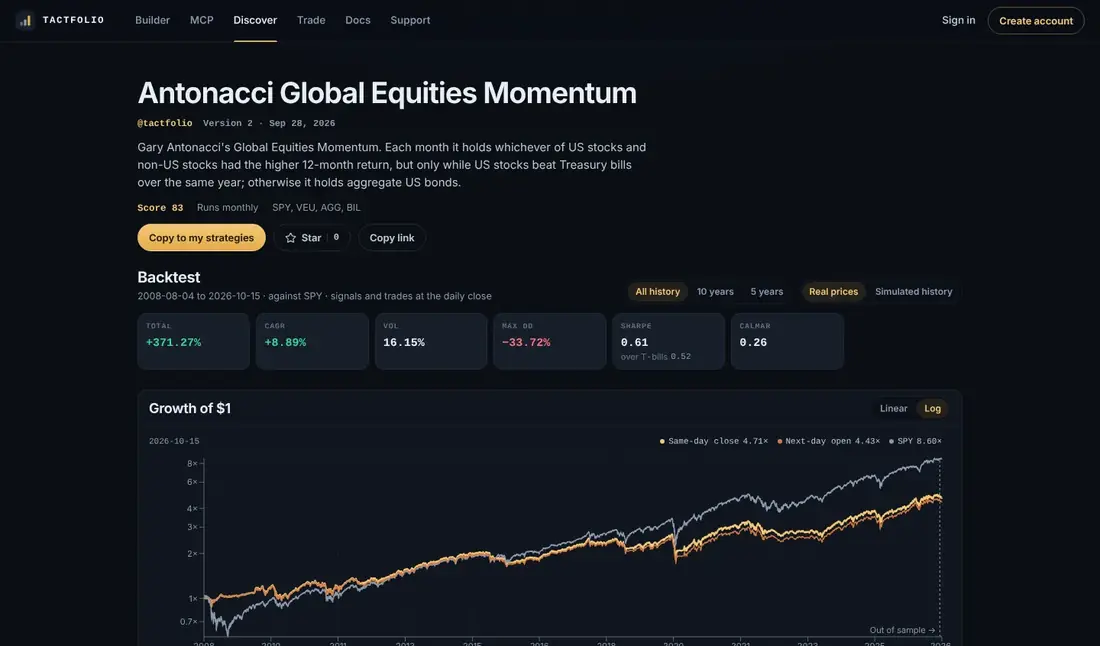
- Every public strategy shows its exact rules, its backtest, and an “Out of sample” line from the day it was published.
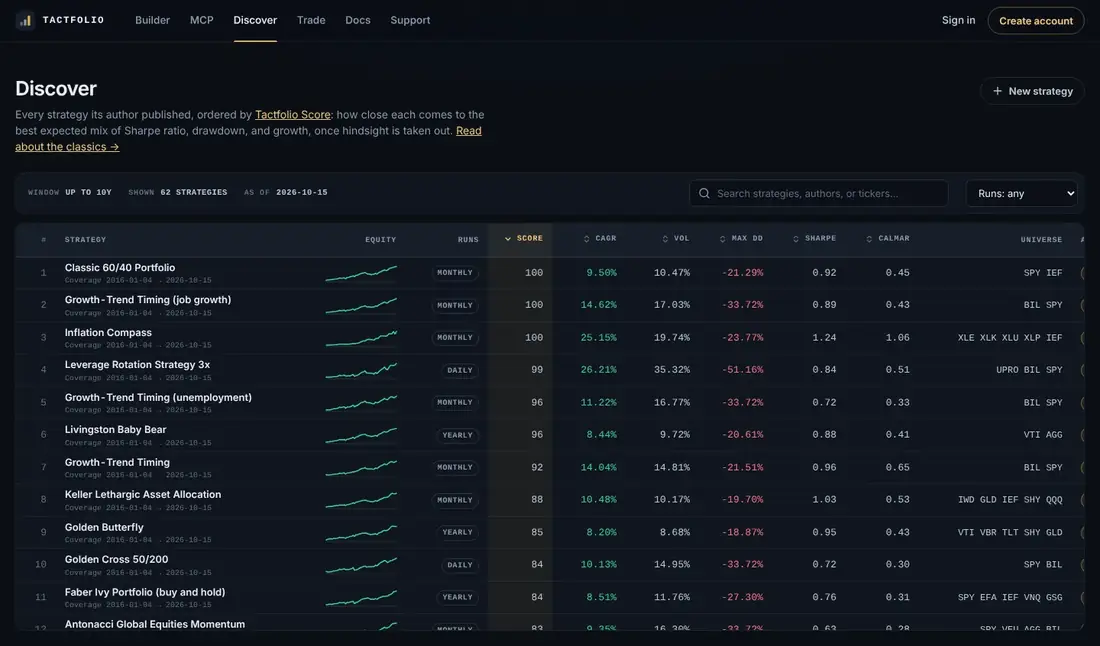
- Discover ranks every public strategy by the Tactfolio Score, from 1 to 100.
- You can copy a strategy, change it, or use it as a building block in your own. The author keeps the credit.
- You run your copy on paper or in your own Alpaca account. It trades once a day at most, long only, in US stocks and ETFs. A copy of a Hyperliquid crypto perp strategy is backtest and paper or testnet only.
Open the builderFree while we build. Look around without an account.
What is copy trading?#
Copy trading is a service that trades your money based on the trades of another trader. That is how Europe’s market regulator, ESMA, describes it. Social trading is the wider idea: traders share what they do, and others follow them. Mirror trading is an older name for copying a strategy’s signals.
Copying a person has a weak spot. You see their results, but often not their reasons. A trader with a great year may have taken big risks or been lucky. When they change their mind, your account changes with them.
How copying a strategy works on Tactfolio#
On Tactfolio you copy a strategy, not a person. A strategy is a written set of rules, so you can see every reason before you copy anything.
- Browse Discover. It lists every published strategy with its score, growth, drawdown, and other numbers over up to 10 years. You can search by strategy, author, or ticker.
- Open a strategy. Its page shows the rules as a tree, the backtest, and the list of versions. No account is needed to look.
- Copy it. Choose Copy to my strategies. You get a private draft of the exact version you were looking at.
- Change it or combine it. Edit anything you like. Or add a Strategy block to your own strategy and pick a published one. That block stays on one exact version, so the author’s later changes never reach you unless you choose to update.
- Run your copy. Start it on paper, or in your own Alpaca account. Your copy follows its own rules from then on.
Copy trading vs copying a strategy on Tactfolio#
| Typical copy trading | Copying a strategy on Tactfolio | |
|---|---|---|
| What you copy | Another person’s live trades | A published set of rules |
| What you can check first | The leader’s past results | The exact rules, the backtest, and the record since publishing |
| Who decides your trades | The leader | Your copy’s rules |
| If the author changes their mind | Your trades change too | Nothing changes until you choose to update |
| Where your money is | Usually with the copy trading provider | In your own Alpaca account, or pretend money on paper |
How to judge a strategy before you copy it#
A high rank is a starting point, not a reason. Check these five things first.
- Read the rules. If you can’t explain the strategy in two sentences, don’t run it yet.
- Look past the “Out of sample” line. Results after that line came after the rules were fixed, so nobody could have tuned them. It is the most honest part of the chart.
- Check the max drawdown. A max drawdown is the biggest fall from a high point. Ask yourself whether you could sit through it.
- Check the costs. The “Reality checks” table repeats the trades at higher costs. A strategy that only works with tiny costs is fragile.
- Prefer a reason. A rule with a clear idea behind it, like “hold bonds when stocks trend down”, tends to last longer than a rule found by trial and error.
How the Tactfolio Score works explains the ranking. How to read a backtest explains the numbers.
A strategy’s past results are not a promise. The author is not your adviser and does not know your situation.
Social trading on Tactfolio#
Social trading on Tactfolio means sharing rules, not trades. Members publish strategies, and everyone can see, test, and build on them.
- Publishing. Any member can publish a strategy under a public handle. Its page shows the rules, the backtest, and every version.
- Discover. Every published strategy is listed in one place, ranked by the Tactfolio Score. You can sort by growth, drawdown, Sharpe, and more.
- Stars and follows. Star a strategy to keep it on your list. Follow an author to find their strategies in Discover.
- Credit. When you copy a strategy or use it inside your own, the page says where it came from. Authors’ profiles show how many stars, followers, and copies their work has earned.
- A live record. Each published version keeps running on new prices from the day it went public, so time tests every claim.
There are no comments and no feed. Talk about strategies wherever you already talk about investing, and bring a link.
Who publishes the strategies#
Tactfolio members publish their own strategies under a public handle. A pseudonym is fine. The Tactfolio team also publishes more than 60 classic strategies from books and research papers, such as Mebane Faber’s 10-month moving average rule. Each classic has an article with its sources.
Published versions are permanent. An author can’t quietly delete a bad version or rewrite its history. They can only publish a new version, and the page lists every one.
What are the best copy trading apps?#
The best copy trading app depends on what you want to copy: a person’s trades, a famous portfolio, or a set of rules. These are the apps we checked on October 16, 2026:
| App | What you copy | Markets | Where trades go |
|---|---|---|---|
| ZuluTrade | Trades of ranked traders it calls Leaders | Mostly forex and CFDs | An account at a partner broker |
| Collective2 | Trades of strategy managers, on a live record | Stocks, options, futures and forex | Your own account at a supported broker |
| Autopilot | Portfolios inspired by politicians, famous investors and funds | Securities your broker trades, without options or short positions | Your own account at brokers such as Robinhood and Schwab |
| Tactfolio | A published set of rules you can read, test and change | US stocks and ETFs | Your own Alpaca account, run as your own copy |
Copying a person means you trust their next trade, which you cannot see ahead of time. Copying rules means you can test them on past prices first. A strategy’s past results are not a promise. The author is not your adviser and does not know your situation.
Full comparisons: Tactfolio vs ZuluTrade, Tactfolio vs Collective2 and Tactfolio vs Autopilot.
What Tactfolio does and does not do#
| Tactfolio does | Tactfolio does not |
|---|---|
| Let you copy, change, and combine published strategies | Mirror another person’s live account |
| Show each strategy’s rules, backtest, and record since publishing | Let authors trade for you or see your account |
| Run your copy on paper, or in your own Alpaca account | Work with any broker other than Alpaca |
| Rank public strategies by the Tactfolio Score | Copy crypto, forex, options, or CFD traders |
| Keep the author’s credit on every copy | Charge fees or pay authors today |
Try it on Tactfolio#
Open Discover and sort by the column you care about most. Pick one strategy and read its rules. When you find one you understand, open the builder, copy it, and run your copy on paper first. If you would rather start from your own idea, see AI trading to build one with an AI assistant.
Open the builderFree while we build. Look around without an account.
Keep learning#
- Max drawdown: the worst fall from a peak, and why it matters before you copy.
- Sharpe ratio and Calmar ratio: two ways to weigh return against risk.
- Tactical asset allocation: the kind of strategy most public strategies use.
- Best tactical asset allocation tools: where else you can follow these strategies.
- AllocateSmartly alternatives and Composer alternatives: other tools, side by side.
Common questions#
Is copy trading legal?#
Rules for copy trading services differ by country. Tactfolio is not a copy trading service in that sense. It does not trade for other people or manage money. You run your own copy of a strategy in your own account.
Does the author see my trades?#
No. Nobody sees your account or your trades. A strategy’s page shows only how many copies people made and how many other strategies use it.
What happens when the author updates the strategy?#
Your copy doesn’t change. It is yours. If you used the strategy as a building block, your strategy stays on the version you picked. The builder offers the update with the author’s note, and you decide.
Is copying a strategy free?#
Yes. Copying, changing, and running a copy on paper are free while we build. Pricing comes with live trading.
Can I copy a strategy without an account?#
You can look at any public strategy without an account. To copy one, save it, or run it, you need a free account.
Sources
- Supervisory Briefing on Copy Trading (ESMA35-42-1428), European Securities and Markets Authority, accessed October 16, 2026