Put your investing rules to the test.
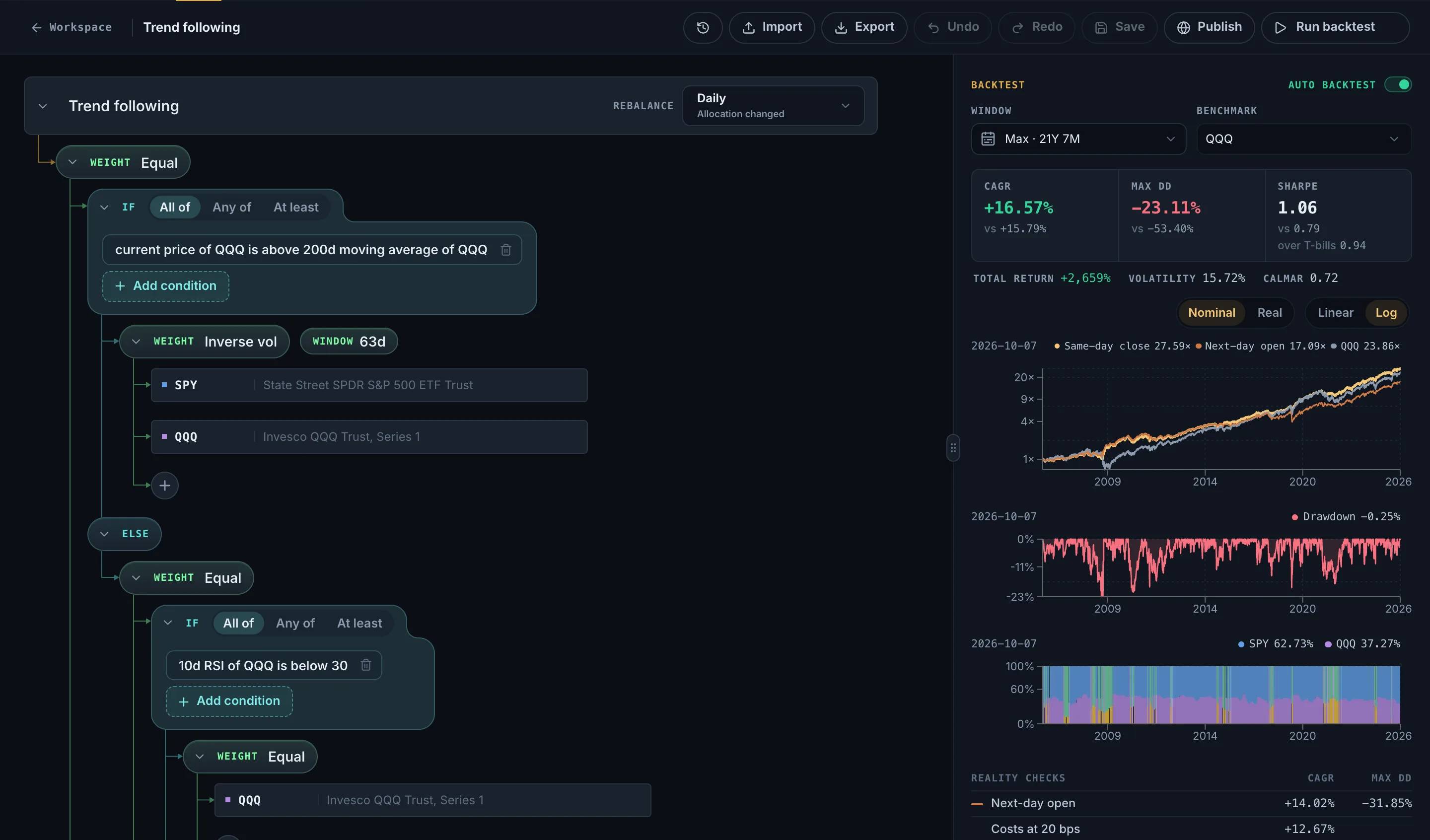
Tactfolio is a visual builder for rules-based portfolios. Say when to hold what, such as stocks while the market trends up and bonds when it doesn’t, and see how that plan would have played out on real prices, bad years included.
Free while we build. Look around without an account.
Start from a pattern, not a blank page
Four starter patterns are ready to open: trend following, buying dips, momentum rotation, and a fixed mix. Each shows its last ten years next to buying and holding QQQ, including where it fell short.
See the patterns →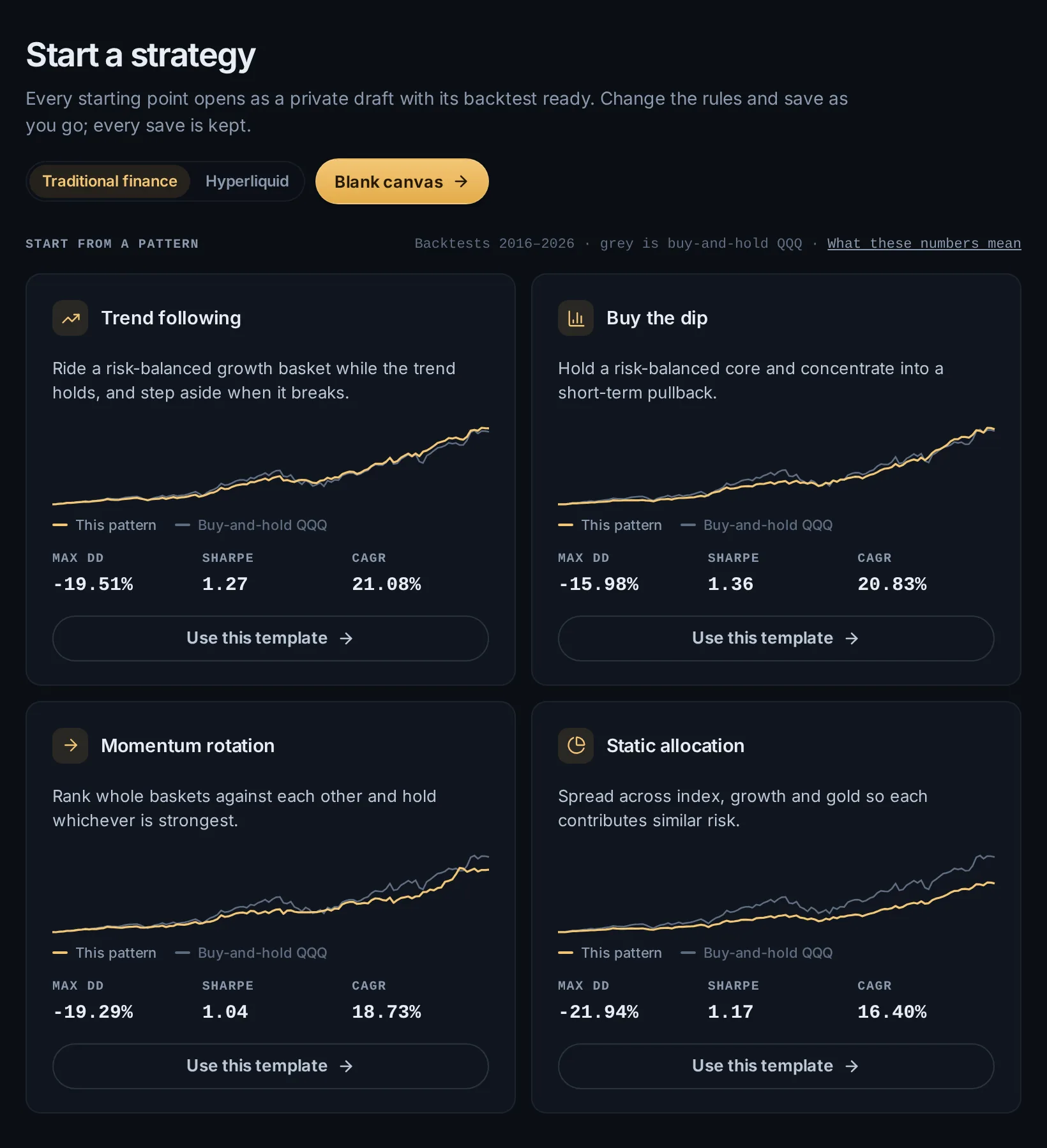
Rules you can read
A strategy is a tree of plain blocks. Change a number and the backtest reruns.
- If
If this, then that
If QQQ is above its 200-day average, hold stocks. Otherwise, hold gold and bonds.
- Rank
Rank and pick
Each month, hold whichever of four funds did best over the last three months.
- Weight
Mix
Split money equally, by percentages you choose, or so each holding carries a similar amount of risk.
Numbers that don’t flatter
Every backtest shows growth next to a benchmark, the deepest drop along the way, and what the strategy holds today. Trades happen at the day’s close, each one pays a small cost, and no rule sees a later day’s prices.
It still can’t tell you what comes next. Why past results mislead →
- Daily prices adjusted for splits and dividends
- Same dates for the strategy and its benchmark
- Trading costs charged on every trade
- Every save kept as a revision you can trace
Bring your AI assistant, if you use one
Connect Claude, ChatGPT, Claude Code, Codex, Cursor, or another assistant that supports MCP. Describe an idea in a sentence. It builds the strategy, runs the backtest, and saves a draft you can check in the builder.
Connect an assistant →Hold QQQ while it is above its 50-day average and the VIX is under 25. Otherwise split between IEF and BIL. Backtest it from 2010 and save it as a draft.
- Built the rules as a strategy
- Ran the backtest from 2010 to today
- Saved it as a draft in your builder
One place for every step
Build a rule, test it on real prices, try it with pretend money, then let it trade your own Alpaca account.
- AI tradingAsk an AI assistant to build and test rules
- BacktestingTest rules on decades of real prices
- Paper tradingRun a strategy with pretend money
- Alpaca tradingTrade a strategy in your own Alpaca account
- Automated tradingLet a strategy trade on a daily schedule
- Quant tradingRules based investing without writing code
- Copy tradingCopy a published strategy and run it yourself
- Crypto backtestingHyperliquid perps: backtest and paper or testnet only
Explore the research
Strategies, fund data, guides and free tools, all on the same daily prices the builder uses.
Classic strategy library
63 well known strategies from books and papers, each with its rules, its sources and a backtest updated every day.
Community strategies
Strategies members published, ranked by the Tactfolio Score. Read the rules, then copy one into your own account.
Trading bot templates
Free trading bot templates built from published strategies. Read every rule and backtest, then run one on paper or in your own Alpaca account.
Investing and trading guides
43 short guides in plain words, from what an ETF is to how a backtest can fool you.
ETF fees, returns and drawdowns
162 funds with their yearly fee, returns by year, worst drop, and the strategies that hold them.
ETF comparisons
16 popular pairs, such as VOO vs VTI, compared on fees and returns over the same dates.
ETF alternatives
The closest funds to 158 ETFs, such as QQQ and SCHD, with fees and returns on the same dates.
Free trading calculators
14 free tools for margin, position size, CAGR, dividends and more, each with its formula and a worked example.
Tactfolio compared with other tools
Side by side pages on Tactfolio and other backtesting and trading tools, with dated facts and their sources.
Docs and how it works
How the builder, backtests, sharing and AI assistant access work, step by step.
What’s ready
Build and test
- The visual builder and four starter patterns
- Backtests on daily prices, with drawdowns and holdings
- Revision history for every strategy
- AI assistant access over MCP
Trade
- Paper trading at real market prices, with a daily summary
- Your own Alpaca account, paper or live
- Orders placed by your strategy, with your own API keys
Everything is free while we build. See the plans for when paid plans open.